
A new wooden floor can change the feel of a room more than almost anything else. In an older house in Dunblane, Bridge of Allan or Stirling, though, the floor you choose has to cope with more than footfall. Uneven joists, draughty voids, damp-prone ground floors, underfloor heating and doors that were hung decades ago all have a say in what will work. Getting the choice right at the start saves a lot of frustration later.
This guide walks through the three types of floor most homeowners weigh up, solid wood, engineered boards and laminate, and the questions worth asking before you commit to any of them.
The three main options
Solid wood
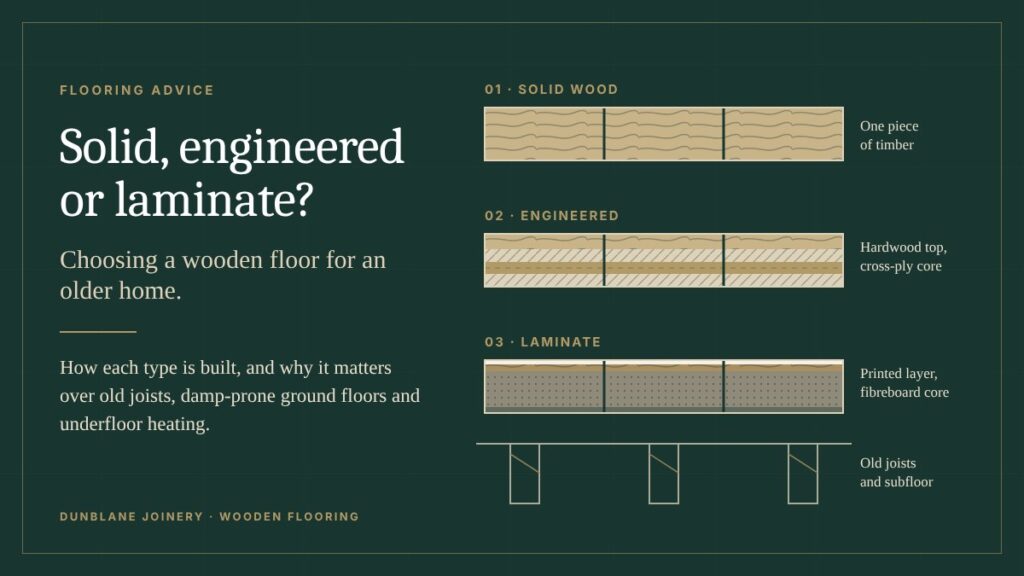
Solid boards are milled from one piece of timber through their full thickness. Their great strength is longevity. Because the wearing layer is the whole board, a solid floor can be sanded back and refinished several times over its life, which is why so many Victorian and Edwardian floors are still in service today. Solid wood suits rooms with stable conditions, such as bedrooms, dining rooms and upstairs living spaces, and it is the natural choice where you want a floor that matches the age and character of a period property.
The trade-off is movement. Solid timber takes up and gives off moisture with the seasons, so it expands and shrinks more than other options. It needs a sound, level, dry base, sensible expansion gaps at the edges and time to acclimatise to the room before it is laid. It is usually a poor match for underfloor heating or for rooms where humidity swings a lot.
Engineered boards
Engineered flooring has a real hardwood top layer bonded to a stable core of plywood or softwood layers laid in different directions. From above it looks and feels like a solid wood floor, but the cross-layered core makes it far less prone to cupping and gapping when conditions change.
That stability is why engineered boards are often the practical choice for older Scottish homes. They cope better over underfloor heating, in kitchens and in ground-floor rooms where the base is less predictable. The number of times an engineered board can be sanded depends on how thick its hardwood top layer is, so it is worth checking that detail on the product specification rather than assuming every engineered floor can be refinished in the same way.
Laminate
Laminate is not timber on the surface. It uses a printed decorative layer under a hard, clear wear layer, on top of a fibreboard core. Good laminate is hard-wearing, easy to clean and usually the most budget-friendly of the three. It can work well in busy family rooms, rented properties or spaces where a floor may be replaced within a few years anyway.
It cannot be sanded and refinished, and deep damage usually means replacing boards. Standard laminate is also vulnerable to standing water, so it is not usually a good fit for bathrooms or areas near external doors, unless the product is specifically made for wetter rooms.
Five questions to answer before you choose
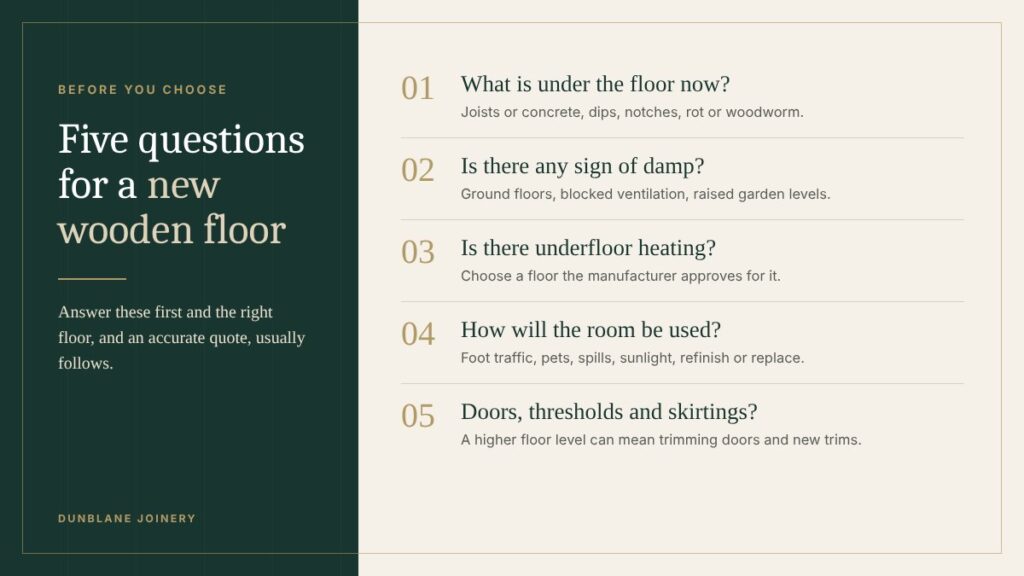
1. What is under the floor now?
The base matters as much as the boards. A suspended timber floor on joists behaves very differently from a concrete slab. Older homes often have joists that have dipped, been notched for pipes or cables, or show signs of rot or woodworm near outside walls. A joiner will want to lift a board or two, check the joists and look at the condition of the subfloor before recommending a finish. Uneven or springy areas need sorting out first, because no new floor will hide them for long.
2. Is there any sign of damp?
Ground floors in traditional stone houses can be prone to damp, particularly where ventilation under a suspended floor has been blocked by later alterations or garden levels have risen against the wall. Laying any timber or fibreboard floor over a damp base is asking for trouble. Testing for moisture, clearing blocked air bricks and fitting an appropriate membrane where needed are all part of good preparation.
3. Will the floor sit over underfloor heating?
If you have, or plan to install, underfloor heating, choose a floor the manufacturer approves for that use and follow their guidance on maximum surface temperature and installation method. In most cases this points towards engineered boards or a suitable laminate rather than solid wood.
4. How will the room be used?
A hallway in a house with dogs, children and muddy boots needs a tougher, more forgiving finish than a quiet bedroom. Think about foot traffic, the chance of spills, direct sunlight that can fade some finishes, and whether you would rather sand and refinish a floor in years to come or simply replace it.
5. What happens at doors, thresholds and skirtings?
Every new floor raises the finished level slightly. In an older house that can mean doors that now catch, thresholds that need new trims and skirtings that need to come off and go back on. These details are where a joiner’s experience shows. Planning them at the quotation stage avoids the common situation where a lovely new floor is let down by doors that drag or awkward gaps at the edges.
Restoring original floorboards
Before choosing anything new, it is worth asking what is already there. Many period homes around Dunblane and Bridge of Allan still have original pine boards under carpet or vinyl. Where the boards are sound, careful repair, replacing damaged sections with matching timber and filling gaps, followed by sanding and finishing, can give a floor with real character that suits the house. Not every original floor is worth saving, but it is a conversation worth having before the old boards go in a skip.
Finding the right fitter
Floors are unforgiving of poor preparation, so it pays to choose a fitter carefully. Ask how they will check the subfloor, how they deal with doors and skirtings, which underlay or membrane they intend to use and whether the quotation includes removing the old floor and disposing of it. Photographs of the room, rough measurements and a note of any heating under the floor will help any joiner give you a more accurate price.
Most people now start that search online, often by typing something like “flooring fitter near me” and comparing what comes up. We see this side of things every day in our local search and website work for trade businesses, and the most useful sites are the ones that show real local projects, explain how the work is done and make it easy to send photographs. Those signs are worth looking for, whoever you ask to quote.
Planning a new floor in Dunblane or Stirling?
Dunblane Joinery fits solid wood flooring, engineered flooring and laminate flooring for homes across Dunblane, Bridge of Allan, Stirling and the surrounding area, along with the facings and skirtings and door adjustments that a new floor often needs. See our wooden flooring service for more detail, or send us a few photographs of the room and we can talk through the best option for your property.